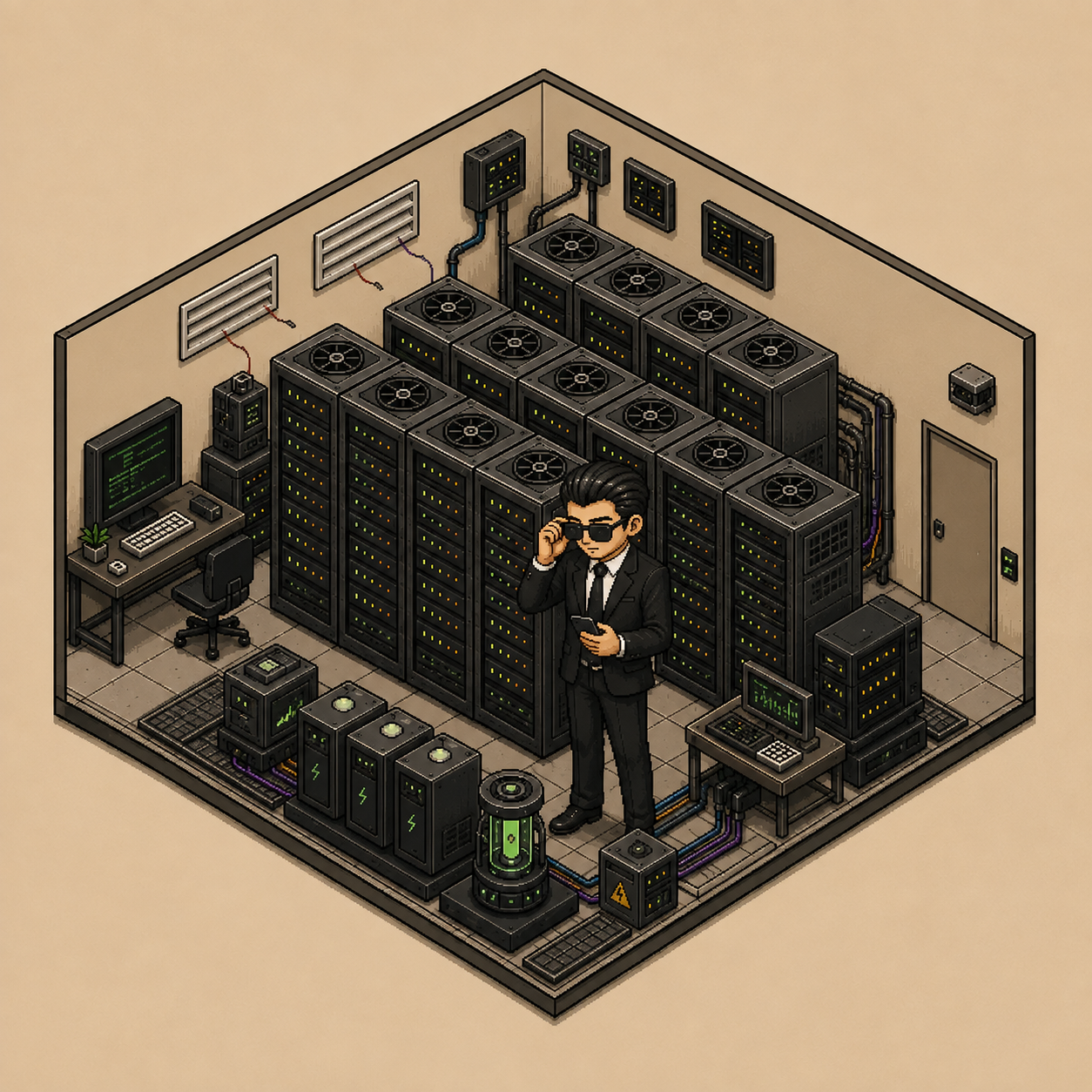
One room. One operator. One vault on Ethereum.
Every round, the pot buys real tokenised stock and splits it across every live vault. Sell the NFT and the book walks with it.
10 ETH and the NFT goes on-chain
Launch sequenceThe protocol pays for its own deployment, in the open. Every creator fee from $BXT lands in wallets you can watch on Solscan — that is what funds the NFT. At 2.6 ETH the program account is affordable and the DataCenter collection can go on-chain. At 10 ETH desk #1 is minted and 5,000 vaults open — whitelist first.
No presale. No allocation. No team wallet. No countdown we control. The only number that decides the date is the one below, and you can verify it yourself right now.
- done$BXT launches
The token trades on Pump.fun. Creator fees start settling into the protocol treasury.
- nowTreasury reaches 10 ETH
Fees accumulate in public. The number below is two wallets read live on chain — not a progress animation, and it can go down.
- 03nextThe NFT program deploys at 2.6 ETH
Rent for the program account is 2.446 ETH — measured against the compiled 321 KB binary at the allocation we actually use — so it can go on-chain well before the mint target. Then the Metaplex Core collection, the config and the pot PDA, and DataCenter #1 minted to the protocol to prove the whole path on mainnet before anyone pays for it.
- 04nextMint opens
Whitelist first, then public. Burn 100,000 $BXT plus 0.5 ETH for one room, one operator, and a vault only that NFT can own.
 DataCenterWhat you mint. Real tokenised stock, held on chain, one NFT, one book.
 BrokerWhat you become at mint. One seat, one vault, one handle on the tape.
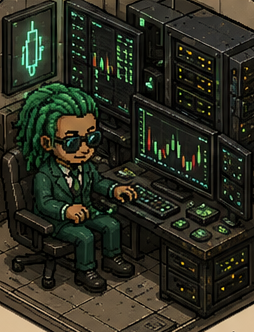
 OperatorYour file. Ten rooms, ten operators, one gifted with your room.
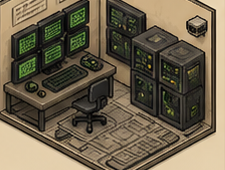 SocialHubWhere brokers talk. Posts, follows and calls with a name behind them.
Walk the building
Ten rooms · ten operatorsA DataCenter is one of these rooms. The operator who works it comes with it — you do not hire them, they are already in the room. Inside sits a vault only that NFT can own. 5,000 desks, then the door closes.
What you are actually buying
The mechanicsA DataCenter is not a picture with a promise attached. It is an NFT that owns an account, and a program that can put tokenised stock into that account and can never take it out. Here is the whole loop, in order.
- 01You burn to mint
100,000 $BXT is destroyed — not sent to us, destroyed — plus 0.5 ETH. Of that surcharge 0.45 goes to the pot that buys stock and 0.05 to the protocol. The split is in the program, not in a promise.
- 02You get a room, an operator and a vault
One of ten rooms, the operator who works it, and a vault PDA the NFT owns. Supply is capped at 5,000 and the cap cannot be raised — the instruction that changes parameters refuses any value above the current one.
- 03Every round buys the next name
When the pot clears 0.1 ETH it buys the next asset in the rotation and credits every activated vault the SAME amount. The share is fixed the moment the round opens, so a vault activated mid-round cannot dilute the ones already counted.
- 04Selling the NFT sells the book
The vault has no stored owner. Ownership is whoever holds the NFT right now, read at instruction time — a stored owner goes stale the moment it sells on a marketplace, and that is how a vault gets credited to a wallet that no longer holds it.
Nobody, yet. There was no presale, no allocation and no raise. The deployment is funded by $BXT creator fees accumulating in a wallet anyone can watch, and the program goes on-chain when that wallet can afford the rent — 2.6 ETH, which is the measured cost of the account, not a round number someone picked. Mint opens at 10 ETH.
 AAPLx
AAPLx MSFTx
MSFTx NVDAx
NVDAx AMZNx
AMZNx CRCLx
CRCLx SPACEX
 ANTHROPIC
 POLYMARKET
 KALSHI
 NEURALINK
Tokenised wrappers that trade on Ethereum. Not the listed security, and not a claim on one.
- No withdraw instruction exists. Not for you, not for the authority. The only way to realise a vault is to sell the NFT that owns it.
- The supply cap cannot be raised. A cap that can be raised is not a cap.
- The keeper has no authority. It can open a round and pay desks. It cannot mint, change a split, or move a vault.
- Pausing does not strand stock. Rounds and delivery keep running while mint is paused, so the pot cannot buy something it then refuses to hand over.
001
All








GENERATE
Launch a memecoin on Ethereum. Creator fees buy tokenised stock for its holders — 70 / 15 / 5 / 0.